Evaluating Watercolor Cascading Wildflowers Patterns for Creative Projects
The Watercolor Cascading Wildflowers Pattern represents a specific aesthetic choice within the realm of digital design resources, characterized by organic floral arrangements that flow vertically or diagonally across a surface. Unlike rigid geometric repeats or isolated clip art, these patterns mimic the natural, untamed growth of meadow flowers, rendered with the soft edges and translucent layering typical of traditional watercolor painting. For designers, crafters, and small business owners, selecting the right pattern involves more than just visual preference; it requires an understanding of resolution, file utility, and how the specific style aligns with the intended end product.
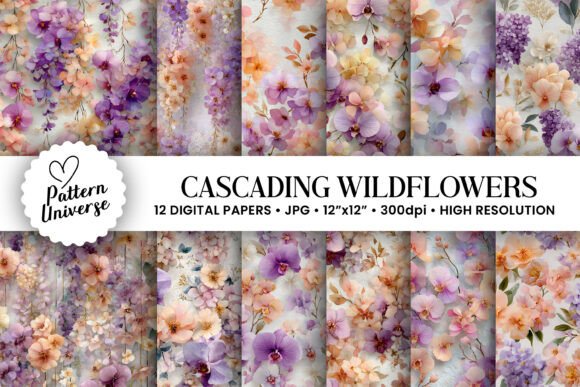
This evaluation focuses on a specific collection comprising 12 seamless AI-generated patterns. These digital papers are designed to serve as versatile backgrounds and textures for a wide array of applications, ranging from commercial gift wrapping to personal junk journaling. By examining the technical specifications and stylistic attributes of these assets, users can determine if this particular set meets their project requirements.
Understanding the Aesthetic and Technical Composition
The core appeal of the Watercolor Cascading Wildflowers Pattern lies in its ability to introduce movement and depth to flat surfaces. The "cascading" element suggests a directional flow, which can guide the viewer's eye across a page or package. This is distinct from all-over prints where elements are scattered randomly. In this style, stems and blooms often drape or tumble, creating a sense of elegance and fluidity.
The collection in question offers 12 unique variations within a single zip file. This variety is crucial for users who need cohesion across multiple items without monotony. For instance, a stationery suite might require a primary pattern for letterheads and a subtler variation for envelope liners. The fact that these are AI-generated indicates a blend of algorithmic precision and artistic styling, allowing for complex details that might be time-consuming to paint manually while maintaining the organic look of handcrafted art.
From a technical standpoint, the utility of any digital paper is dictated by its resolution and dimensions. These files are provided at 300 DPI (dots per inch), which is the industry standard for high-quality printing. Anything below 300 DPI risks appearing pixelated or blurry when printed, especially on larger formats. Furthermore, the file size of 3600 x 3600 pixels (equivalent to 12 inches by 12 inches at print resolution) ensures that the patterns can be tiled seamlessly or used as full-page backgrounds without loss of quality. This specification makes them suitable for professional-grade outputs rather than just screen-based viewing.
Practical Applications and Suitability
Determining whether this pattern set is a strong fit depends largely on the nature of the project. The versatility of the Watercolor Cascading Wildflowers Pattern makes it applicable to several distinct categories of creation:
- Packaging and Wrapping: The seamless nature of the files allows them to be tiled infinitely, making them ideal for custom gift wrap. The cascading design works particularly well on cylindrical objects like tumbler wraps, where the vertical flow complements the shape of the cup.
- Paper Goods and Stationery: For greeting cards and invitations, the soft watercolor texture provides a romantic or rustic backdrop that does not overpower text. The 12x12 inch size is also compatible with standard scrapbooking layouts and junk journal backgrounds.
- Wall Art and Decor: With 300 DPI resolution, these patterns can be printed on canvas or heavy cardstock to create framed wall art. The organic subject matter fits well in nurseries, kitchens, or spaces aiming for a cottage-core or botanical aesthetic.
- Digital Design: Beyond physical printing, these high-resolution files can be imported into design software for use in digital planners, website backgrounds, or social media graphics.
Users involved in selling handmade goods, such as on Etsy or at local craft fairs, will find value in the commercial potential of these assets. Having 12 coordinated designs allows for the creation of product lines—for example, a matching set of notebooks, tote bags, and greeting cards—thereby enhancing brand consistency.
Benefits and Considerations for Selection
When evaluating this resource against others, several benefits stand out. First, the seamless quality of the patterns eliminates the need for complex editing to hide edges. Users can repeat the image horizontally and vertically without visible breaks, which is essential for large-format printing like wallpaper or fabric. Second, the inclusion of 12 variations in one download offers immediate variety, reducing the time spent searching for complementary designs.
However, there are tradeoffs and considerations to keep in mind. While AI generation allows for intricate detail, it may occasionally produce botanical inaccuracies, such as impossible stem connections or non-existent flower species. For projects requiring strict botanical correctness, this might be a limitation, though for decorative purposes, the artistic impression usually suffices.
Additionally, the watercolor style relies heavily on white space and transparency. If a user intends to print on colored or kraft paper, the lighter parts of the watercolor wash may disappear or blend into the background, altering the intended look. These patterns are best utilized on bright white or off-white substrates to maintain the contrast and vibrancy of the cascading flowers.
When to Consider Alternatives
While the Watercolor Cascading Wildflowers Pattern is robust for many uses, it may not be the optimal choice for every scenario. Users seeking a modern, minimalist, or industrial look might find the floral motif too traditional or busy. In such cases, geometric patterns, solid textures, or abstract line art would be more appropriate alternatives.
Furthermore, if a project requires vector scalability (the ability to resize infinitely without any pixelation regardless of original dimensions), raster-based images like these 3600x3600 pixel files have a hard limit. While 12x12 inches is sufficient for most craft projects, users planning to print massive banners or billboards would need to seek vector file formats (such as SVG or EPS) instead of high-resolution PNGs or JPGs.
Another consideration is the color palette. Watercolor sets often come with a fixed color scheme. If a project demands specific brand colors that differ significantly from the soft pastels or earth tones typically found in wildflower sets, recoloring a complex watercolor texture can be difficult and may result in a loss of the natural shading effects. In these instances, starting with line art or creating custom illustrations might be a better workflow.
Making the Decision
Selecting the right digital assets is a balance between aesthetic vision and technical necessity. The Watercolor Cascading Wildflowers Pattern collection described here offers a strong solution for those needing high-resolution, seamless botanical backgrounds for paper crafts, packaging, and decor. Its strengths lie in its print-ready resolution, seamless tiling capability, and the organic elegance of the cascading composition.
For individuals focused on junk journaling, scrapbooking, or creating cohesive stationery suites, this set provides a practical foundation that saves time on design while ensuring professional print quality. However, users with needs for infinite scalability, specific non-floral themes, or printing on dark substrates should carefully weigh these factors before purchasing. By aligning the specific attributes of these 12 digital papers with the concrete goals of the project, creators can ensure the final output meets both their artistic standards and functional requirements.